
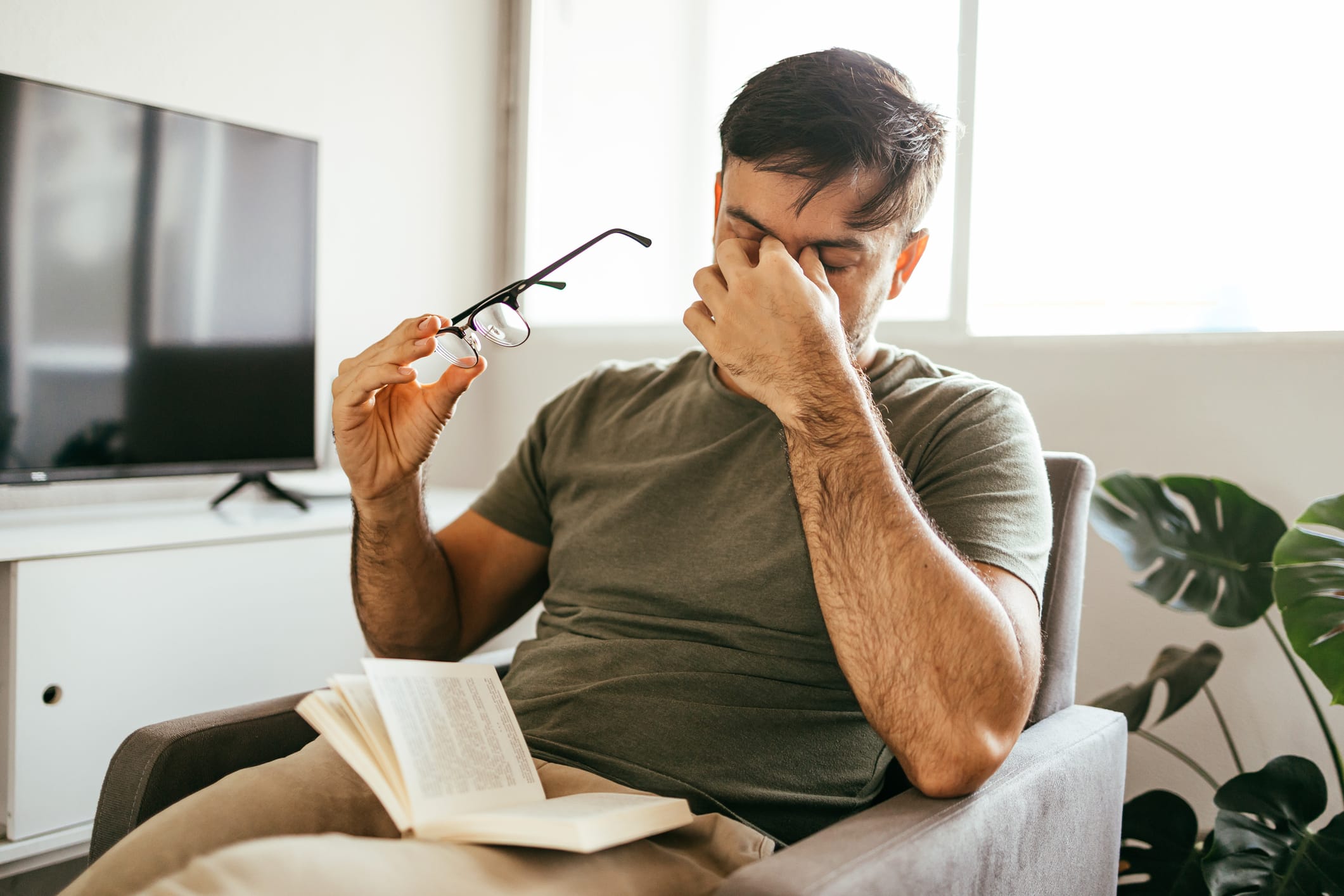
In roughly half of patients, the first sign of myasthenia gravis (MG) appears as muscle weakness around the eyes. Around 85% of patients develop weakness in other parts of the body within the next few years — but in the other 15% of patients, symptoms never move beyond the eyes. This is called ocular myasthenia gravis.
What are common eye symptoms?
There are a few eye symptoms that are commonly seen in patients with MG. They often get worse as the day goes on and the eye muscles become more fatigued. Some patients find many everyday tasks, especially driving, to be challenging.
Ptosis
One of the most common symptoms is drooping eyelids, otherwise known as ptosis. You may experience the drooping of one or both of your eyelids. This typically worsens if you are using your eye muscles for an extended period of time, such as when reading a book.
Diplopia
Some patients also experience double vision, also known as diplopia. Double vision occurs because the eye muscles become too weak to coordinate the movement of the eyes. As long as there is some form of misalignment in the vision between the two eyes, diplopia can occur.
Other symptoms of eye muscle weakness
Another common eye symptom in MG is an inability to maintain a steady gaze. Patients may have trouble following a moving object. Some patients also experience dry eye.
Learn more about MG signs and symptoms
What causes eye muscle weakness?
MG disrupts the communication between nerve and muscle, causing muscle weakness and other symptoms. In many patients, this is caused by the body producing antibodies against acetylcholine receptors, proteins that helps relay signals between nerve and muscle cells. The muscles in and around the eyes have fewer acetylcholine receptors and contract more quickly than other muscles, so they both react differently to the disease than other muscles, and are more likely to tire from use.
What can help?
There are a number of therapies that can alleviate eye symptoms in MG. Among them are acetylcholinesterase inhibitors, which work by increasing the chemicals that carry signals from the nerve to the muscle. Corticosteroids are also frequently prescribed, as they can help calm an overactive immune system.
Take regular breaks to rest your eyes. Blocking the vision of one eye with an eye patch may help with double vision. Ptosis props (also called eye crutches) can help with drooping eyelids; these are thin bars that attach to the upper rim of your glasses to hold drooping eyelids open.
Your eye doctor and the rest of your care team will carefully monitor your health and tailor your treatment to ensure that your eye symptoms are dealt with as adequately as possible. If you are taking a corticosteroid you are at an increased risk of glaucoma or cataracts; your eye doctor will carefully monitor for early signs of these developing.
Sign up here to get the latest news, perspectives, and information about MG sent directly to your inbox. Registration is free and only takes a minute.
